How a Welqin Transaction Works
Every filing instruction, office action, status update, or invoice exchanged between IP professionals carries the same kind of information — who it's from, who it's for, what IP right it concerns, what's being asked or reported, and often a document to go with it. Today, that information travels as free text in an email, or as a PDF nobody's system can read automatically. Welqin replaces that with something both sides' systems can understand without a human retyping it in the middle.
One standard, not one company's format
Welqin isn't a proprietary format invented to lock in its users. It's built on AFNOR NF X50-276, a data exchange standard developed over five years by a community of IP professionals — private-practice firms, corporate IP departments, service providers, IPMS vendors, and patent offices — under the aegis of AFNOR, the French national standards body. First published in 2018 and updated in 2025, it's the only standard purpose-built to describe IP-related transactions in a structured, unambiguous way.
Welqin operates the network built on top of that standard. The distinction matters: adopting Welqin doesn't mean adopting Welqin's format — it means adopting an open, community-governed standard that Welqin happens to make usable today, through a network already connecting IP firms, corporates, and offices.
This is the same shift SWIFT brought to banking: before SWIFT, banks exchanged payment instructions by telex, each in their own shorthand, reconciled by hand. SWIFT didn't move money — it gave every bank a shared language to describe a transaction, so the systems on both ends could talk directly. Welqin is that shared language for IP.
What travels in a transaction
Welqin calls a single transaction a Flow. Whatever it's about — a filing instruction, a deadline report, an invoice — a Flow is built from the same small set of building blocks, so that receiving software only ever has to understand one shape of message, not one per sender:
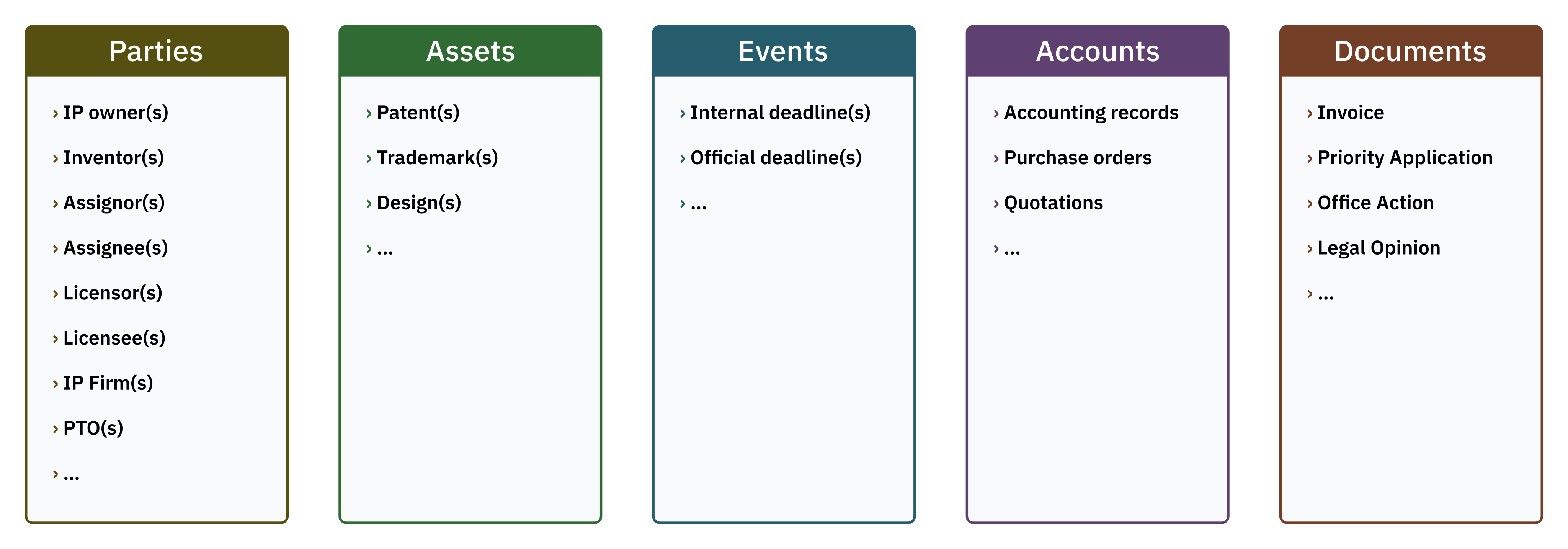
Because every Flow is built from the same pieces, a firm's IPMS — or Welqin's own portal, for firms not ready to integrate directly — only needs to learn this shape once to handle every kind of transaction that comes through the network.
From one system to another
Emission from the source IPMS
No manual entry. No PDF conversion.

A Flow's journey is tracked from submission to delivery, so both sides always know where a transaction stands — submitted, in progress, delivered, or returned for correction — without a status-check email. If something's wrong with a transaction, the receiving agent returns it with a reason instead of it silently sitting in an inbox; the sender corrects it and resubmits, and the exchange continues on the same thread.
Connecting to the network doesn't require replacing anything. Firms and corporates connect their existing IPMS through a simple import/export, a direct API integration, or by using Welqin's own portal while they evaluate the shift — all three interoperate on the same network, at each side's own pace.
A concrete example: sending an invoice
Take something every firm does constantly — billing a client or a foreign associate for work done. As a Flow, that invoice carries:
- the sending and receiving agents, and which one is the recipient of this particular invoice;
- the invoice itself — its reference number, issue date, currency, and the full legal identity of who's billing whom (name, address, tax and registration numbers) — attached directly to the invoice so it's self-contained, not looked up separately;
- the individual billing lines behind it — professional fees, official fees paid to a patent or trademark office, expenses — each tagged with what procedural task it relates to and how it should be categorized, so a billing system can post it to the right account without a person deciding that manually;
- the invoice PDF itself, attached to the transaction (not emailed separately, and not a link that can go stale).
Everything totals up automatically checkable at the receiving end, in a single declared currency, with no ambiguity about what a given line means or where it should land. What used to be a PDF attached to an email, manually re-entered by someone on the receiving end, arrives instead as data the receiving system can post directly.
Why this compounds
A single connection is useful. What makes the network valuable is that it's the same connection for every counterpart. A firm that connects once can exchange structured Flows with every other agent already on Welqin — other firms, corporate IP departments, service providers, and, over time, patent and trademark offices — without negotiating a bespoke integration for each one. The more of the IP world that's connected, the less anyone has to re-key.
A more detailed, developer-facing description of the Flow structure and a full worked example are available in our technical documentation.